Measure without touching
Radar senses the surface from above. Mounting on a cap, rail, bridge, or gantry can avoid placing a sensor in the liquid.
Monitor pools, tanks, reservoirs, and rivers in one place. FlowAlarm turns radar readings into clear trends and timely alerts so you can plan your next move.
Non-contact radar. Wi-Fi or LTE. Built to fit your site.
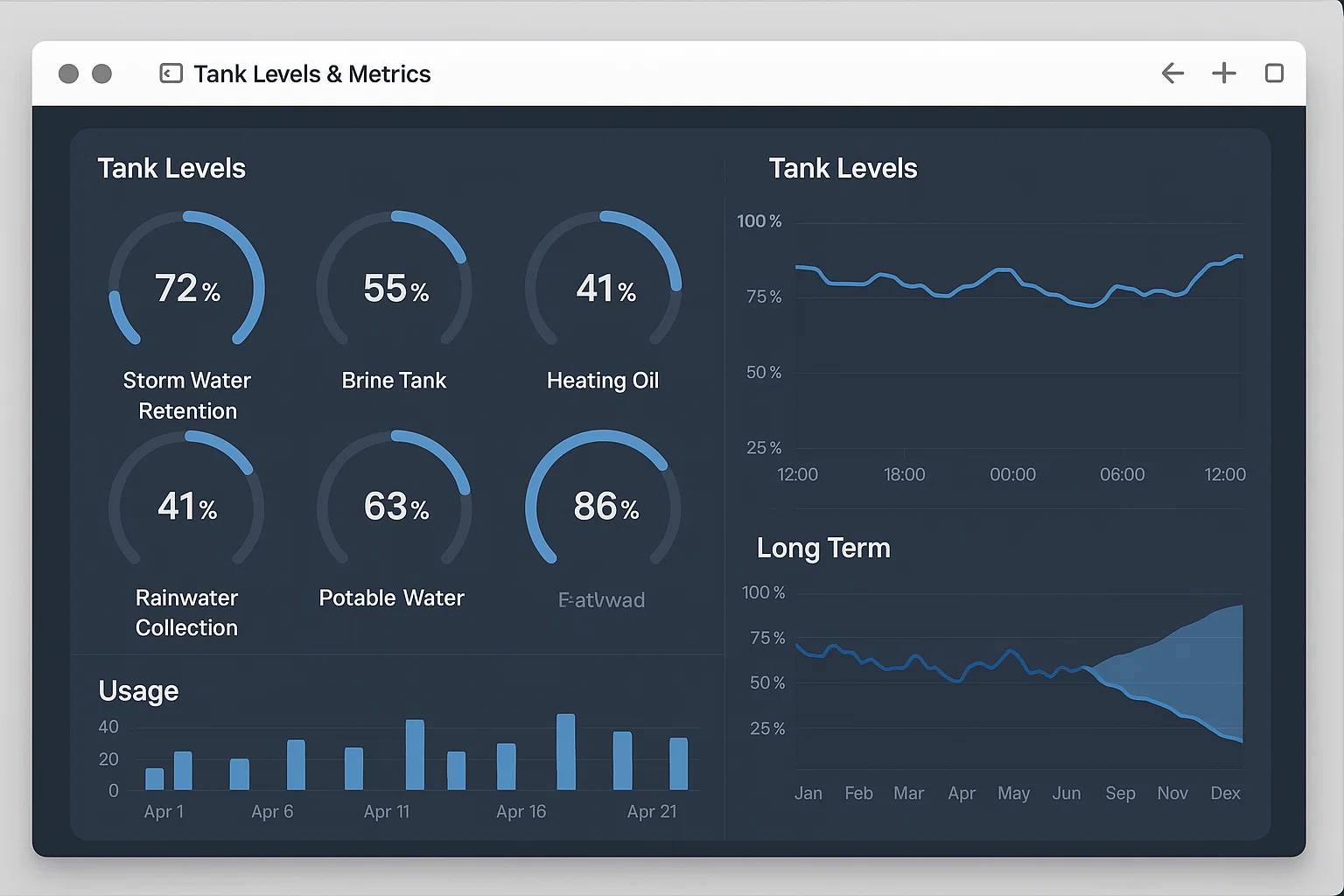
A level reading tells you where things stand. A trend shows how they are changing. Bring both together to spot refill needs, rising levels, and unusual patterns.
Radar senses the surface from above. Mounting on a cap, rail, bridge, or gantry can avoid placing a sensor in the liquid.
View readings over time and use low-level, refill, and overflow warnings to decide when to investigate or take action.
Compare locations in a unified dashboard. Ask about APIs and connections to your building or industrial control systems.
Both models support secure provisioning, remote firmware updates, and store-and-forward readings through connection gaps.
Use your existing network for pools, campuses, plants, and other built environments.
Use cellular connectivity for remote tanks, rivers, reservoirs, and temporary sites.
Track changes and plan top-offs while watching for unusual or rising levels.
Watch inflow and outflow during changing weather to support pump and gate decisions.
Mount above the surface to track water level, often called stage, over time.
Bring level data into oversight and control workflows.
Monitor source basins, process tanks, and storage locations from one view.
Review inventory and delivery needs. Confirm liquid and installation compatibility during scoping.
Identify the liquid, mounting point, level range, and available connectivity.
Use Wi-Fi where a network is available, or LTE for remote and temporary locations.
Choose thresholds and recipients that match the way your team responds.
Review changes, plan refills, and use readings to support operational decisions.
Wi-Fi suits places with an existing network, such as pools, campuses, and plants. LTE uses cellular connectivity and suits remote tanks, rivers, reservoirs, and temporary sites. Coverage and power should be confirmed during planning.
Both model types support store-and-forward operation, which holds readings during a connection gap and sends them when the connection returns.
Ask about API access, municipal telemetry, and building or industrial control integrations. We will review your environment and the required workflow before recommending a deployment.
Tell us what you monitor, where it is, and what connectivity is available. We'll help identify a model and deployment plan.